
A studio can be profitable on paper and still fail to make payroll. This sounds like a contradiction the first time you hear it, and it confuses nearly every owner who runs into it, because profit and cash feel like they should be the same thing. They are not, and the gap between them is where otherwise healthy creative studios quietly die. Understanding that gap, and learning to manage it, is probably the single most useful money skill a small studio owner can develop, more useful than any pricing trick or tax strategy, because it is the thing that keeps the doors open long enough for everything else to matter.
This guide explains cash flow in plain language, why creative studios are especially exposed to cash flow trouble, the specific things to watch, and the practical levers that keep the bank account full enough to sleep at night. No accounting background required.
Profit is an opinion, cash is a fact
Start with the core distinction, because everything else follows from it.
Profit is an accounting concept. It is what is left when you subtract your costs from your revenue over some period, on paper. It answers the question "did this work make money in principle." It is, in a real sense, an opinion, because it depends on when you decide to count revenue and costs, and accounting rules give you latitude there.
Cash flow is the actual movement of money in and out of your bank account, in real time. It answers a blunter question: "is there money in the account right now to pay what is due." It is not an opinion. The balance is the balance. A payment either cleared or it did not.
Here is how the two come apart, in the scenario that catches studios out. You finish a $20,000 project in March. On paper, March was a great, profitable month; you earned $20,000 against, say, $12,000 of costs, so you booked $8,000 of profit. But the client pays on net 30 terms, so the actual cash does not land until late April. Meanwhile, you paid your team their March salaries in late March, and you will pay them again in mid-April, all before that $20,000 arrives. For several weeks, you are simultaneously profitable (the project made money) and broke (there is no cash in the account to cover payroll). The profit is real and the cash crisis is also real, and they coexist. Studios do not usually fail from lack of profit. They fail from running out of cash while waiting for profit to arrive.
Once you internalize that profit and cash are different things on different timelines, the whole topic clicks into place. Managing cash flow is managing timing: making sure money arrives in the account before it has to leave.
Why creative studios are especially exposed
Every business deals with cash flow, but creative studios feel it more sharply than most, for structural reasons worth understanding because they tell you where your risk concentrates.
The work is lumpy. Creative studios tend to live on projects, which arrive irregularly and pay irregularly. A big project lands and the account is flush; it wraps, there is a gap before the next one, and the account drains. This feast-or-famine rhythm means cash arrives in bursts but goes out steadily, which is inherently harder to manage than a business with smooth, predictable monthly revenue.
Costs are steady even when income is not. Salaries, rent, software, and subscriptions go out every month at the same time regardless of whether a big payment came in. The mismatch between lumpy income and smooth outgo is the core of studio cash flow stress. In a busy month it is invisible; in a gap month, those fixed costs keep draining an account that nothing is refilling.
Payment terms create a built-in delay. The standard practice of billing clients on net 15, net 30, or worse means you routinely deliver work and then wait weeks to be paid for it, all while your own costs for doing that work have already gone out. You are, in effect, lending your clients the cost of their projects for the length of your payment terms.
Clients pay late. On top of the agreed delay, real clients pay later than their terms, stretching the gap further and less predictably. A studio planning around net 30 that actually collects in net 45 is short of cash for an extra two weeks it did not budget for.
Put together, these mean a creative studio is almost designed to have money tied up in work it has done but not yet been paid for, while steady costs drain the account in the meantime. That is not a sign you are running the studio badly. It is the default condition of the business model, which is exactly why actively managing cash flow matters so much.
The numbers to actually watch
You do not need to become an accountant to manage cash flow. You need to watch a small number of things honestly and regularly. Here are the ones that matter.
Your cash position and runway. The most important number, full stop: how much cash is actually in the account, and if income stopped tomorrow, how many months of costs could you cover from what you have. That second figure is your runway, and for a studio with payroll it is not optional knowledge. Runway under three months should change your behavior, making you more aggressive about collecting, more cautious about spending, and more focused on filling the pipeline. Many owners have never calculated their runway and would be unsettled by how short it is, which is precisely why it is the first thing to know.
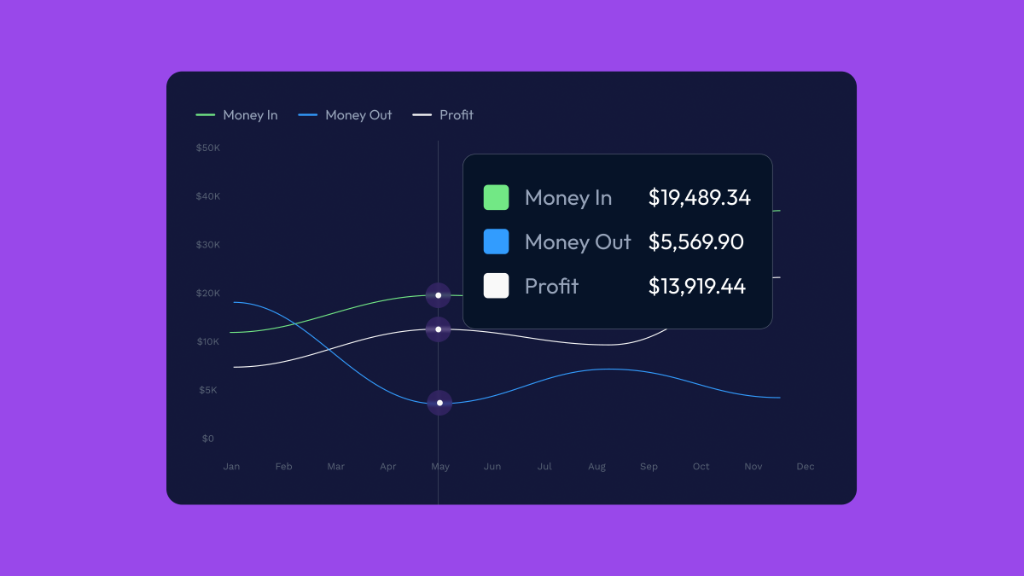
Money in versus money out, by month. The heartbeat of the business: in reality, not projection, are more dollars arriving than leaving this month. Watching this trend across months reveals seasonality, the slow patch forming before it bites, and the quiet creep of costs you did not notice rising. A studio that watches money-in-versus-out monthly is rarely blindsided by a cash crunch, because it saw the trend bending the wrong way in time to act.
Outstanding invoices and their age. Money you have earned but not collected is not cash; it is a promise. A studio can be owed $40,000 and still bounce a payment, because the $40,000 is sitting in clients' accounts, not yours. Watch the total outstanding and, more importantly, how old each piece is. An invoice a week past due is a quick nudge; a pile of invoices sixty days past due is a developing hole. The age of your receivables is an early-warning system, and ignoring it is how a manageable situation becomes a crisis.
Upcoming large outflows. Cash management is also about seeing what is coming. A quarterly tax payment, an annual software renewal, a planned hire, these large, irregular outflows can blindside a studio that is only watching the day-to-day. Knowing they are coming lets you reserve for them instead of being surprised.
These four (runway, monthly flow, aged receivables, upcoming outflows) are enough. The goal is not a sophisticated financial model. It is to never be surprised by the state of your own bank account.
The levers that improve cash flow
Here is the encouraging part: improving cash flow rarely requires more revenue. It mostly requires shrinking the gap between when money goes out and when it comes in. These are the levers, roughly in order of impact for a typical studio.
Take deposits. The single most powerful cash flow lever for project work. A deposit before you start means cash arrives before you incur the costs, flipping the usual timing in your favor. Thirty to fifty percent upfront covers your early outgo and dramatically eases the strain. For larger projects, milestone payments throughout (a portion at kickoff, at a midpoint, at delivery) keep cash flowing in alongside the costs rather than all at the end, so you are never floating the entire project.
Shorten your payment terms. The terms you set determine how long you wait. Defaulting to net 15 instead of net 30 roughly halves the delay, and most non-enterprise clients accept it without blinking because they have simply never been asked for shorter. You set the terms; choosing shorter ones is free and pulls all your incoming cash earlier.
Invoice immediately. Every day between finishing work and sending the invoice is a day added to the front of the payment clock. The studio that finishes on the 2nd and bills on the 30th has voluntarily added nearly a month of delay. Invoice the moment work or a billing period is done, and the cash arrives that much sooner. This is the cheapest, fastest improvement available and the one most studios neglect.
Chase overdue invoices early and systematically. Late payments are a major cash flow drag, and most of the damage is preventable by catching them early. An invoice five days overdue, nudged immediately, usually pays quickly. The same invoice ignored for sixty days becomes a real problem. A reliable follow-up rhythm, reminders before the due date, on it, and after, keeps your receivables young and your cash flowing. Automating those reminders means it happens even in the busy weeks when you would otherwise forget, which are exactly the weeks invoices slip.
Manage the outflow side too. Know which of your costs are fixed and which are flexible, so that in a tight month you know what can be paused or deferred. Time large discretionary outflows for when cash is strong rather than when it is thin. And resist the temptation to inflate fixed costs during a flush month, because those costs will still be there during the lean one.
Build a buffer. Ultimately, the cushion against cash flow shocks is reserve cash, built during good months, that covers your costs through the bad ones. A studio with two or three months of operating costs set aside turns a cash flow scare into a non-event. The buffer is built by treating a portion of every strong month as not-for-spending, which is the same discipline that smooths the whole feast-or-famine cycle.
Notice that almost none of these require winning a single new client. They are all about timing, collection, and discipline, which is why cash flow is so improvable even when revenue is flat.
Seeing it clearly is most of the battle
The reason most studio owners do not actively manage cash flow is not that they do not care. It is that assembling the picture by hand is genuinely miserable. To know your real position you would have to export bank statements, sort transactions into money-in and money-out, figure out which deposit was a client payment and which was a transfer, cross-reference against which invoices are still unpaid, and tally upcoming costs, and it would all be out of date within days. So owners do not do it, and they run on a vague feel for the balance until the feel fails them at the worst moment.
The fix is to stop assembling it by hand and have it stay current on its own. When your bank feeds in automatically and transactions are categorized into money in and money out, your cash position and monthly flow are simply there, live, with no spreadsheet session. When your invoicing lives in the same place, you can see at a glance what you are owed, how overdue it is, and therefore what cash is actually likely to arrive and when. The slow month stops being a surprise that hits when a payment bounces and becomes something you watch approaching with time to steer around it.
This is a core reason MoolaX connects to your bank and tracks cash flow automatically, pairing the money-in-and-out picture with the invoicing side so the two halves of the cash flow equation sit together. You see the cash you have, the cash you are owed, when it is likely to land, and whether your real balance can cover what is due before it. For a business whose survival depends on timing, that visibility is the difference between managing your cash flow and being managed by it.
The mindset shift
The deepest change is to stop thinking about your business only in terms of profit and start thinking in terms of cash timing. Profit tells you whether the work is worth doing. Cash flow tells you whether you will still be in business next month to do more of it. Both matter, but in the short run, cash is the one that can kill you, and it is the one studios pay the least attention to.
A studio owner who watches runway, invoices immediately, takes deposits, chases late payers early, and keeps a buffer is running a fundamentally more resilient business than an equally talented one that only looks at whether projects were profitable. The work can be identical. The survival odds are not. Cash flow management is unglamorous and it is, quietly, what separates the studios that last from the ones that were profitable right up until the month they could not make payroll.


